More redacted poetry from song lyrics. James McMurtry’s “Hurricane Party” for brain injury recovery.
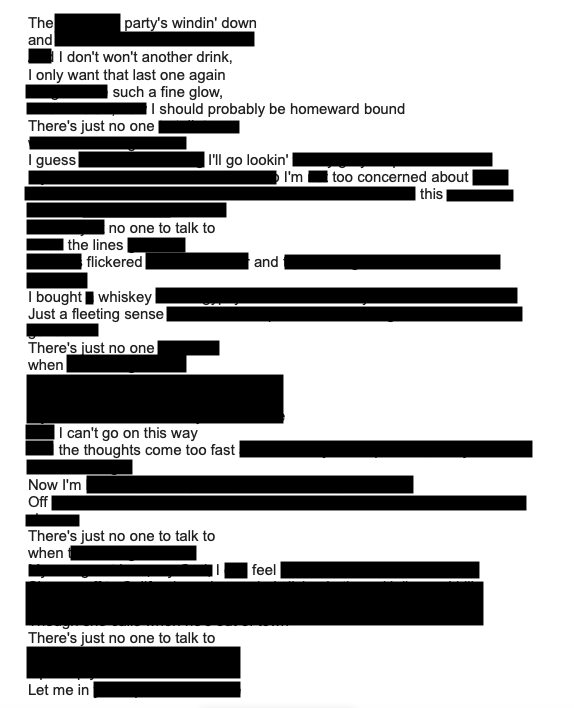

More redacted poetry from song lyrics. James McMurtry’s “Hurricane Party” for brain injury recovery.
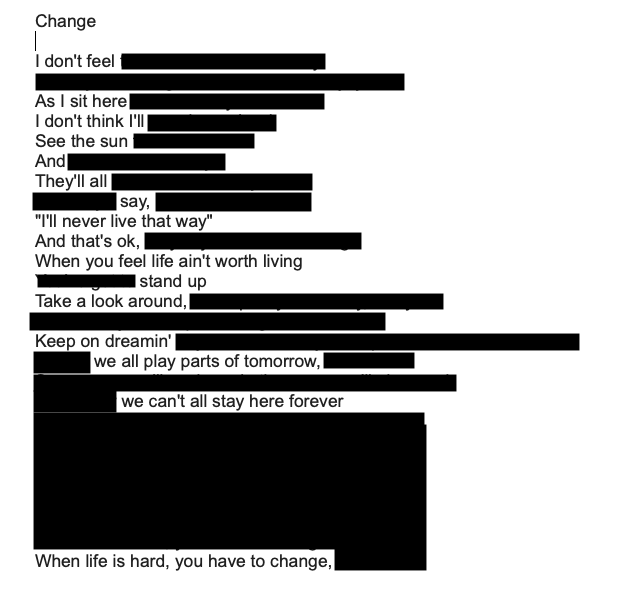
More redacted poetry from song lyrics. Blind Melon’s “Change” for brain injury recovery.
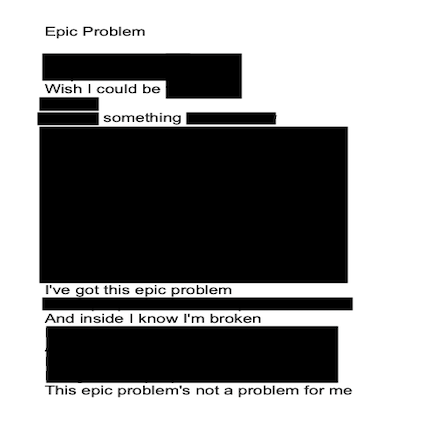
More redacted poetry from song lyrics. Fugazi’s “Epic Problem” for brain injury recovery.
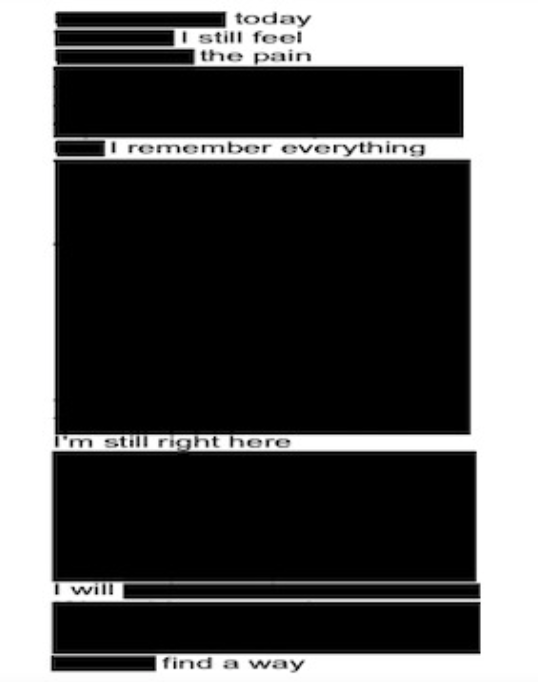
One of the projects we did, redacted poetry. The lyrics from “Hurt” applied to brain injury recovery.
“the only true currency in this bankrupt world is what you share with someone else when you’re uncool.”
“We don’t make mistakes, just happy little accidents” – Bob Ross
When Sony began fast-tracking development of The Quick and the Dead, the studio commissioned a series of rewrites from Moore. The writer was eventually dismissed and replaced with John Sayles, who, according to Moore, was chosen because the studio did not like the semi-serious tone and instructed him toward “making more of an American Old West film”. Moore was rehired and filming was to begin in three weeks because Sayles’s script was approaching a 2½-hour runtime. When rewriting the shooting script, Moore omitted Sayles’s work without Sony noticing. A week before shooting, Sony considered the script good enough to shoot; Moore described the rewrites as “a completely f–king pointless exercise”
“So there was an assignment to write, you write a page that has no dialogue in it…you show a character trait through action, with no dialogue. I had read this great script by David Mamet, which was Hoffa…and there was a great scene…where Danny DeVito is driving along…and it shows what he’s going through by the method he uses to keep himself awake while driving, which is he lights a cigarette…and he let’s it burn down to his fingers to keep him awake. And it’s just so simple, and perfect, and lovely, and it’s Mr. Pulitzer Prize himself, David Mamet. So I took that page, and I handed it in. And it got a C+…There’s a wonderful thing that if you drop out quick enough, you get your tuition back.”
 Andrew Davie